
Buffalo’s Waterfront Renaissance recounts how the opening of the Erie Canal in 1825 catapulted Buffalo to become one of the most important hubs of commerce and industry in the country. The book also highlights the environmental and social consequences of this rapid development—specifically, how industries took over the waterfront, leading to severe contamination and limiting public access to the waterfront for decades.
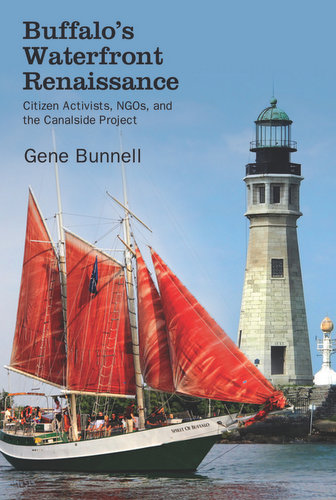
Buffalo’s once-polluted waterfront began a remarkable transformation in the early 2000s, largely driven by citizen initiatives. The first step in the recovery was the environmental cleanup and restoration of the Buffalo River spearheaded by the nonprofit Friends of the Buffalo River (now Buffalo Niagara Waterkeeper), which over time made the river corridor a destination for recreation and an increasingly appealing area in which to live and work.
The book also chronicles how the Canalside Project was made possible by the lawsuit the Preservation Coalition of Erie County filed against Empire State Development Corporation and how ESDC’s consultant attempted to justify keeping the Commercial Slip buried by floating the bizarre theory that the stones that lined the Commercial Slip would “blast apart” if exposed to the air after having been buried so long. The theory was initially taken seriously by the court but was debunked when interviews with geologists at the University at Buffalo revealed it had no scientific basis. In the end, the state agreed to uncover, reconstruct and re-water the Commercial Slip and make it the centerpiece of Canalside.
Another controversial state waterfront agency plan called for a large Bass Pro retail outlet to be built on the footprint of the historic Central Wharf which overlooked Buffalo’s Harbor during the Canal Era. Four months after a rendering of the proposed project appeared in the Buffalo News the plan was scrapped due to an outpouring of public opposition. A publicly beneficial outcome brought about as a result is the 1000-foot-long waterfront promenade that now provides uninterrupted public access to the waterfront.
Other Inner Harbor initiatives and outcomes described in the book include:
- The restoration of the 1828 lighthouse at the entrance to the Inner Harbor by the Buffalo Lighthouse Association;
- The Buffalo Maritime Center’s commemoration of the 200th anniversary of the Erie Canal by building a replica of the Seneca Chief canal boat that Gov. DeWitt Clinton boarded and traveled on from Buffalo to New York Harbor in 1825 to mark the opening of the canal;
- The acquisition, restoration and installation of a historic carousel at Canalside by Buffalo Heritage Carousel, Inc.
- Ric and Kathy Hilliman’s purchase of a 73-foot schooner, which they brought to Buffalo, renamed Spirit of Buffalo, and began offering visitors the opportunity to sail out onto Lake Erie from the Commercial Slip.
More recent events described in the book that pertain to the Outer Harbor are particularly worthy of attention. A “Blueprint Plan” for the Outer Harbor developed by ECHDC in 2014 called for the development of 2100 new housing units (mostly condominiums) with retail and commercial space mixed in. A coalition of nongovernmental organizations was formed (called Our Outer Harbor) to oppose efforts by the state agency to privately develop the Outer Harbor. A series of open houses held to solicit public input regarding what should happen made clear that public opinion was strongly against privately developing the Outer Harbor. Heeding that citizen input, ECHDC abruptly changed course and developed a new plan that called for most of the Outer Harbor to be developed and improved as park and open space.
Recounts how preservationists and environmentalists ultimately succeeded in forcing the state waterfront agency to scrap its initial plans for developing the Inner and Outer Harbor, and to embrace new approaches that greatly expanded opportunities for the public to use and enjoy the waterfront.
If you are interested in purchasing the book, click here.
_________________________________________
If you have alumni news you would like to share with the Amherst Alumni community, email alumni@amherstschools.org.





 Tiger Tracks